

 By
By 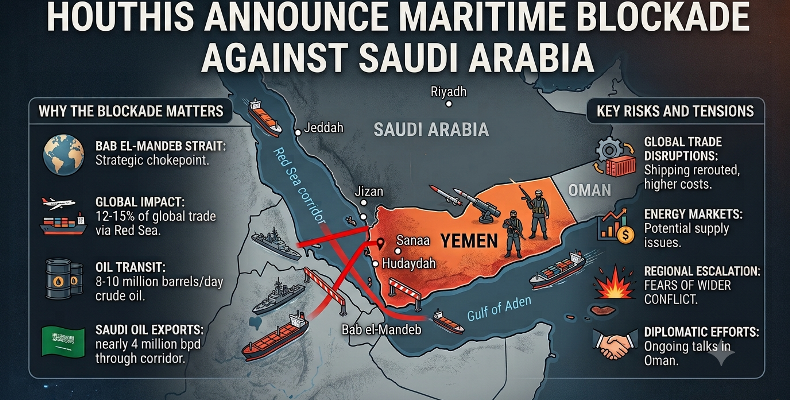
Date: July 20, 2026
The Yemen’s Houthis movement has announced a maritime blockade against Saudi Arabia, marking a significant escalation in the long-running conflict between the two sides. The Iran-aligned group said the blockade would take effect immediately, describing it as retaliation for what it claims was a recent Saudi attack on Sanaa International Airport.
The announcement has renewed concerns over the security of the Red Sea, one of the world’s busiest maritime trade routes, and could have implications for global energy markets and international shipping.
Yemen’s Houthis Declare Immediate Maritime Blockade
A military spokesperson for Yemen’s Houthis, also known as Ansar Allah, announced that all Saudi maritime navigation would be subject to a blockade.
According to the spokesperson, the move follows what the group described as the principle of “an eye for an eye,” arguing that the blockade is a direct response to restrictions imposed on Yemen.
The Houthis also warned that any further military action by Saudi Arabia would trigger a broader response, increasing fears of another cycle of regional escalation.
Why the Blockade Matters
The announcement has drawn international attention because of the strategic importance of the Bab el-Mandeb Strait, a narrow waterway connecting the Red Sea to the Gulf of Aden.
According to industry estimates:
- Around 12–15% of global trade passes through the Red Sea.
- Approximately 8–10 million barrels of crude oil transit the Bab el-Mandeb each day.
- Saudi Arabia exports nearly 4 million barrels of oil daily through this maritime corridor.
If the blockade disrupts commercial shipping, it could affect:
- International oil supplies
- Global shipping costs
- Supply chains across Europe, Asia, and Africa
- Saudi imports and exports
Even limited disruptions in the region have previously caused shipping companies to reroute vessels around Africa, significantly increasing transportation costs and delivery times.
Possible Impact on Saudi Arabia
The Houthis claim the blockade is not limited to oil exports.
According to their statement, commercial vessels transporting imported goods to Saudi Arabia could also become targets under the blockade.
If enforced, this could complicate Saudi logistics and increase pressure on regional trade routes.
However, analysts note that the effectiveness of the blockade will depend on the Houthis’ operational capabilities and the response of international naval forces already active in the Red Sea.
Previous Red Sea Operations
This is not the first time Yemen’s Houthis have attempted to disrupt maritime traffic.
Over the past two years, the group has repeatedly targeted commercial vessels they said were linked to Israel during the Gaza conflict. Those attacks prompted several major shipping companies to suspend Red Sea operations or divert vessels via the Cape of Good Hope.
The Houthis argue those operations were intended to pressure Israel, while many governments have condemned the attacks as threats to international navigation and maritime security.
The latest announcement suggests the group could expand similar tactics toward Saudi-linked shipping if tensions continue to rise.
Ongoing Negotiations in Oman
Despite the latest escalation, diplomatic efforts remain underway.
Reports indicate that Oman continues to host discussions involving Houthi representatives and Saudi officials in an effort to reduce tensions and revive stalled peace negotiations.
Whether these talks produce a breakthrough remains uncertain.
Regional observers believe the outcome of these negotiations may determine whether the current confrontation evolves into a wider conflict.
Background to the Saudi-Houthi Conflict
The conflict between Saudi Arabia and the Houthis dates back to 2015, when the Houthis took control of Yemen’s capital, Sanaa.
Saudi Arabia subsequently led a military coalition supporting Yemen’s internationally recognized government.
Since then, the conflict has involved:
- Airstrikes
- Missile attacks
- Drone operations
- Economic restrictions
- Maritime security concerns
The Houthis continue to accuse Saudi Arabia of maintaining restrictions on airports and ports under their control, while Saudi Arabia maintains that its actions are aimed at supporting Yemen’s recognized government and addressing regional security concerns.
Growing Concerns for Global Shipping
The Red Sea has become one of the world’s most closely monitored shipping corridors due to repeated attacks on commercial vessels.
Shipping companies, insurers, and energy markets are expected to closely monitor developments following the Houthi announcement.
Any sustained disruption could increase freight insurance premiums, delay cargo shipments, and place additional pressure on global energy prices.
International Response Expected
Governments and international organizations are expected to assess the implications of the announcement in the coming days.
Many countries have previously called for protecting freedom of navigation through international waterways while urging all parties to avoid actions that could further destabilize the region.
The coming days will likely determine whether the declaration remains largely symbolic or results in measurable disruptions to maritime trade.
Conclusion
The latest announcement by Yemen’s Houthis represents another significant development in the ongoing conflict involving Saudi Arabia and regional security in the Middle East. While it remains unclear how effectively the group can enforce a maritime blockade, the declaration has already heightened concerns over Red Sea shipping, global trade, and oil supplies.
With diplomatic negotiations continuing in Oman, the international community will be watching closely to see whether dialogue can ease tensions before the situation escalates further.














Comments