

 By
Review By: Marques Brownlee
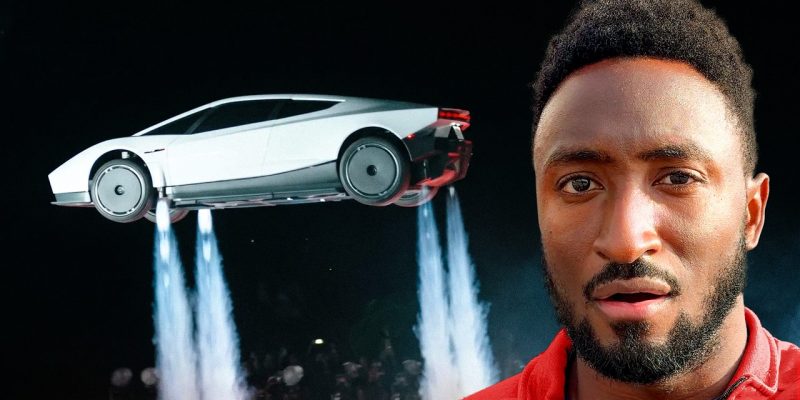
Tesla has once again captured the automotive world’s attention with a dramatic presentation of its next-generation Roadster. The event showcased a redesigned electric sports car, extraordinary acceleration claims, a fan-based downforce system, and demonstrations that appeared to push the boundaries of what a road car can do. Some of the most eye-catching moments included a vehicle driving upside down, performing a spectacular flip, and demonstrating rocket-like propulsion.
However, behind the excitement lies a more complicated story. How much of the new Tesla Roadster represents practical automotive engineering, and how much is an ambitious demonstration designed to generate attention? More importantly, will Tesla deliver a production vehicle that customers can actually purchase and drive on public roads?
In his reaction to the unveiling, technology and automotive reviewer Marques Brownlee examines these questions by separating the most spectacular demonstrations from the vehicle’s underlying engineering. His analysis raises important considerations about performance, safety, road legality, charging technology, and Tesla’s ability to meet its promised delivery timeline.
The new Roadster could become one of the most extraordinary electric sports cars ever produced. Nevertheless, its final specifications, availability, and real-world capabilities remain central questions that prospective buyers should consider.
1. A Completely Redesigned Tesla Roadster
The latest Roadster reveal represents a significant departure from the vehicle Tesla originally presented in 2017. Rather than simply updating the earlier design, Tesla has introduced a substantially different visual direction that emphasizes sharp lines, futuristic styling, and an aggressive supercar appearance.
The new exterior features angular bodywork, distinctive triangular design elements, narrow headlights, and prominent lighting bars at the front and rear. Its upward-opening doors contribute to the dramatic appearance, while the rear section incorporates a large movable wing and several distinctive exhaust-like openings associated with the proposed propulsion system.
The overall styling has a more futuristic character than the earlier Roadster concept. Its geometric surfaces and minimalist appearance create a visual identity that reflects Tesla’s broader design language, particularly the angular aesthetic associated with the Cybertruck.
However, an unconventional design does not automatically translate into better performance. Exterior styling must also accommodate aerodynamic efficiency, cooling requirements, structural integrity, visibility, and pedestrian safety. These considerations become especially important when developing a high-performance electric vehicle intended to operate at extreme speeds.
Brownlee’s initial reaction to the new design was mixed. He preferred the appearance of the original concept and questioned whether the redesigned vehicle would appeal to everyone. This highlights an important distinction between a design that attracts attention at an unveiling and one that remains desirable when viewed as a finished production car.
Ultimately, the new Roadster’s appearance will be judged not only by its visual impact but also by how effectively its exterior design supports its engineering objectives.
2. The Incredible Demonstration: Driving Upside Down and Performing a Flip
The most unusual part of Tesla’s presentation was not the car’s styling or acceleration figures. Instead, the event featured demonstrations that appeared to challenge conventional assumptions about vehicle movement.
One demonstration showed the Roadster climbing a steep structure before reaching an inverted position. The vehicle was presented as generating more than 4,000 kilograms of downforce while stationary on the structure. It then performed a dramatic maneuver involving a flip before returning to the ground on its wheels.
These demonstrations attracted attention because conventional cars depend on tire contact, suspension systems, and aerodynamic forces to remain stable and controllable. A vehicle that can generate substantial downforce at low speeds, maintain an inverted position, and reposition itself through propulsion systems would require a very different engineering approach.
Brownlee noted that the demonstration appeared to be autonomous and pre-scripted rather than an ordinary driving exercise performed by a human driver. That distinction matters because a carefully controlled demonstration can operate under conditions that would be difficult to reproduce safely in everyday traffic.
The presentation also left several practical questions unanswered. For example, what operating conditions are required for these maneuvers? How much energy do they consume? Can the system function reliably outside a controlled demonstration environment? What happens if a sensor, propulsion component, or control system fails during a maneuver?
These questions do not negate the engineering effort involved. They simply illustrate why a successful demonstration should not be confused with proof that a technology is ready for widespread commercial use.
For automotive enthusiasts, the demonstration represents an extraordinary engineering concept. For prospective buyers, however, the more important question is whether any of these capabilities offer a meaningful benefit during normal driving.
3. Understanding the Fan Car Technology Behind the Roadster
Among the technologies discussed in Brownlee’s reaction, the proposed fan-based downforce system may have the clearest connection to practical automotive performance.
Most performance cars rely heavily on aerodynamic downforce to improve grip. As a vehicle travels faster, specially shaped bodywork, wings, diffusers, and other aerodynamic components direct airflow in ways that press the car toward the road.
Greater downforce can increase the load on the tires, helping the vehicle maintain traction through corners and during certain high-speed maneuvers. This is particularly important in motorsport, where small improvements in grip can significantly affect lap times.
However, conventional aerodynamic downforce generally becomes more effective as vehicle speed increases. At lower speeds, the airflow may not generate enough force to deliver the same level of grip.
A fan car approaches the problem differently.
How a fan-based downforce system works
A fan system actively moves air from the area underneath the vehicle, creating a pressure difference between the space below the car and the surrounding atmosphere. The resulting force pushes the vehicle toward the ground.
Instead of depending entirely on forward speed to generate aerodynamic load, a properly designed fan system can produce substantial downforce even when the vehicle is moving slowly or is stationary.
The concept is particularly attractive for track performance because vehicles frequently encounter tight corners, slow turns, and acceleration zones where conventional aerodynamic systems produce less downforce.
In his analysis, Brownlee compares the concept with the McMurtry Spéirling, a compact electric track car developed around fan-generated downforce. The Spéirling demonstrates why this technology attracts attention from performance engineers: it can generate substantial grip without requiring the same high vehicle speeds as conventional aerodynamic solutions.
Tesla’s proposed use of similar technology could give the Roadster a significant advantage if the system performs as described and can be integrated effectively into a production vehicle.
Why additional downforce matters
Imagine two performance cars entering the same corner. One relies primarily on conventional aerodynamic downforce, while the other can actively generate additional downforce at lower speeds.
Under suitable conditions, the second vehicle may be able to maintain greater tire grip through the corner, allowing it to turn more aggressively or accelerate earlier on the exit.
This advantage could also improve traction during acceleration. Electric motors can deliver substantial torque almost immediately, but that power is useful only when the tires can transfer it to the road.
If the Roadster’s proposed fan system improves traction as claimed, it could help explain Tesla’s announced acceleration target of approximately 1.6 seconds from zero to 60 mph for the relevant performance configuration.
That figure should still be treated as an announced target rather than a verified production-car result.
The practical limitations of fan technology
Despite its potential benefits, fan-based downforce introduces engineering challenges that conventional performance cars do not necessarily face.
A system that draws air from beneath a vehicle may also collect dust, gravel, and other road debris. Components positioned close to the road must withstand repeated exposure to uneven surfaces, while flexible skirts or sealing elements may experience wear.
The system also requires additional components, including fans, ducts, controls, protective structures, and potentially replaceable parts. Engineers must consider their weight, reliability, noise, energy consumption, and maintenance requirements.
Road conditions create another complication. Potholes, speed bumps, steep driveways, and damaged pavement could affect components that operate close to the ground. A design that performs exceptionally well on a smooth racing circuit may require substantial adaptation before it becomes suitable for everyday use.
Consequently, the success of Tesla’s proposed fan system will depend on more than the amount of downforce it can generate. Durability, serviceability, road compatibility, and regulatory approval will be equally important.
4. Four Proposed Roadster Configurations
One of the important details discussed after the event was the possibility of four different Roadster configurations: Base, Performance, Thrust, and Rocket.
The distinctions matter because the most extreme demonstrations should not be interpreted as capabilities available on every version of the vehicle.
According to the information discussed in the transcript, the proposed configurations are intended to offer different levels of performance and specialized propulsion technology. The exact specifications and availability of each version should be confirmed against Tesla’s finalized production documentation.
Base: The conventional electric sports car
The Base configuration was described as the most straightforward version, without the additional fan and thrust systems associated with the more ambitious models.
This approach would make sense for buyers interested primarily in electric acceleration, sports-car handling, and the Roadster’s design rather than experimental propulsion features.
A conventional configuration could also avoid some of the complexity associated with active fan systems and compressed-gas propulsion. Nevertheless, its final performance, range, price, and equipment would need to be confirmed before its commercial value could be assessed.
Performance: Greater grip through active downforce
The Performance configuration is described as incorporating the fan-based downforce system.
This technology could offer the most direct practical benefit among the unusual systems discussed during the presentation. Increased tire loading at low speeds may improve cornering performance and traction, potentially making the car more competitive on a race track.
Tesla has been associated with an approximately 1.6-second zero-to-60-mph target for this configuration. Whether the car can achieve that figure consistently under independently tested conditions remains to be demonstrated.
The critical question is whether the additional grip can be delivered reliably without compromising road usability, durability, or safety.
Thrust: Adding compressed-gas propulsion
The proposed Thrust configuration takes the concept considerably further by adding rear-facing thrusters to the fan-equipped vehicle.
The transcript describes a pressure vessel with an approximate capacity of 200 liters, a carbon-fiber-overwrapped construction, and nitrogen stored at a stated pressure of 10,000 psi. The system is intended to release compressed gas through rear-facing outlets to generate additional forward thrust.
This could theoretically help the vehicle accelerate beyond the traction limits imposed by its tires alone, at least for a brief period.
However, a system designed for short bursts of extraordinary acceleration presents practical challenges. The amount of usable thrust depends on the gas supply, pressure regulation, nozzle design, vehicle mass, and the duration for which the system can operate.
It would also require careful consideration of noise, heat or cold effects, pressure-vessel integrity, crash protection, and the safety of nearby people.
The Thrust configuration therefore represents a much more complicated engineering proposition than a conventional high-performance electric car.
Rocket: The most extreme concept
The proposed Rocket configuration adds further thrusters around the vehicle and a substantially larger compressed-gas tank in the passenger area. The transcript describes an approximately 400-liter tank and a configuration that would leave room for only one occupant.
These additional systems were presented as enabling the most spectacular demonstrations, including a jump and a kickflip-like maneuver over a section of road.
The announced acceleration target for this version is approximately 0.6 seconds from zero to 60 mph.
Such a claim would require exceptional evidence before it could be accepted as a production-car performance figure. A demonstration conducted under controlled conditions does not establish that the vehicle can achieve the same result repeatedly, safely, and with a fully representative production configuration.
More importantly, Tesla’s website was described in the transcript as stating that the Rocket version was not approved for public-road use and would be available only by invitation.
This makes it fundamentally different from an ordinary consumer sports car. Its potential significance lies more in experimental engineering and spectacle than in practical transportation.
5. Can the Tesla Roadster Really Accelerate from 0 to 60 mph in 0.6 Seconds?
Acceleration has long been a defining feature of electric performance vehicles. Electric motors can produce substantial torque quickly, allowing electric cars to accelerate rapidly without conventional gear changes.
The proposed Roadster takes that principle to an extreme.
The transcript discusses several acceleration targets, including approximately 1.6 seconds for the fan-equipped Performance version, less than one second for the Thrust configuration, and 0.6 seconds for the Rocket version.
These figures should not be treated as interchangeable. Each configuration uses a different proposed combination of propulsion and traction technologies, and the most extreme claims depend on systems that go beyond conventional electric-motor performance.
The role of tire traction
When a car accelerates, its tires must transfer the driving force to the road. If the requested force exceeds the available grip, the tires can spin instead of producing additional forward acceleration.
Increasing downforce can help by increasing the normal force acting on the tires. However, tire grip is also affected by the tire compound, road surface, temperature, load distribution, and other factors.
This explains why a fan-based system could be relevant to acceleration as well as cornering.
A compressed-gas propulsion system introduces another source of force. By expelling gas backward, a thruster can generate a forward reaction force. In principle, that force does not depend on the tires transmitting all of the propulsion load to the road.
However, adding thrust does not remove the need for stability, directional control, and effective braking. Extreme acceleration can also impose significant physical loads on occupants.
For these reasons, the proposed acceleration figures need independent verification using a clearly defined measurement method, suitable testing conditions, and a production-representative vehicle.
Until those results are available, the figures remain ambitious performance targets rather than established capabilities.
6. Safety Concerns: Pressure Vessels, Noise, and Road Legality
The Roadster’s more conventional technologies raise familiar automotive engineering questions. Its proposed compressed-gas propulsion systems introduce additional concerns that deserve careful examination.
One of the most important is crash safety.
High-pressure gas storage
The Thrust and Rocket concepts rely on large pressure vessels containing compressed nitrogen. According to the transcript, one proposed vessel operates at a stated pressure of 10,000 psi.
Pressure vessels are used in many industrial and transportation applications, but their safe integration into a passenger vehicle requires specialized design and testing.
Engineers must account for impact loads, mounting failures, pressure relief, material damage, temperature changes, and the possibility of a collision involving the storage vessel.
The position of the proposed equipment also matters. If a large pressure vessel is located near the driver’s head or in the passenger compartment, its protection during a crash becomes an especially important design consideration.
It would be premature to conclude that the system is unsafe simply because it uses compressed gas. Equally, it would be premature to assume that a successful demonstration establishes its crashworthiness.
The final vehicle would need to demonstrate that its pressure systems, occupants, and surrounding structures meet the applicable safety requirements.
Noise and exhaust hazards
Compressed-gas thrusters can produce substantial noise during operation. The transcript describes the demonstration taking place at a distance from spectators, who were provided with hearing protection.
This raises questions about whether the system could operate within applicable noise limits in different jurisdictions.
There are also concerns about the direction and force of the discharged gas. Any system that releases gas at high speed must account for the potential effects on nearby people, objects, road debris, and other vehicles.
A system that is manageable on a controlled test site may not be suitable for use in ordinary traffic.
Is the Roadster street legal?
The answer depends on the configuration and the jurisdiction.
A conventional electric Roadster could potentially satisfy public-road requirements if its final design meets applicable vehicle safety, lighting, braking, noise, and other regulations.
A fan-equipped version would need additional evaluation of its components, debris handling, ground clearance, and operating behavior.
The Thrust configuration would face further questions about its compressed-gas propulsion equipment and whether it could comply with road-use requirements.
The Rocket configuration is different because the transcript explicitly describes it as not approved for public-road use.
Therefore, the entire Roadster lineup should not be treated as a single road-legal product. Each configuration would need to be assessed according to its final design and intended use.
7. What the New Roadster Promises Beyond the Stunts
The most dramatic parts of the unveiling received the most attention, but the transcript also discusses several conventional engineering features that could prove more important to the vehicle’s eventual success.
These include the proposed carbon-fiber body panels, a target vehicle weight below 1,700 kilograms, rear-wheel drive, revised electric motors, active aerodynamic components, and advanced chassis systems.
Each of these deserves attention because the quality of a high-performance vehicle depends on how its components work together, not simply on its headline acceleration figure.
Carbon-fiber construction and vehicle weight
Electric vehicles often carry substantial battery mass. Reducing weight can improve acceleration, braking, cornering, and energy efficiency.
Carbon-fiber body panels can help reduce mass compared with heavier alternatives, although the overall vehicle weight depends on much more than the exterior panels. Battery capacity, structural reinforcement, motors, suspension, and safety systems all contribute.
The transcript discusses a target weight below 1,700 kilograms. That is an ambitious figure for a high-performance electric vehicle with the proposed capabilities, but it should be regarded as a target until the production vehicle is weighed independently.
Rear-wheel drive and driving engagement
The proposed use of dual motors at the rear is another notable departure from the all-wheel-drive layouts common in high-performance electric cars.
Rear-wheel drive can offer a different driving character, with the rear tires responsible for transmitting propulsion forces and the front tires primarily responsible for steering.
However, rear-wheel drive does not automatically make a car more engaging or more capable. The outcome depends on torque delivery, weight distribution, suspension geometry, traction control, and the driver’s ability to manage the available power.
If the Roadster uses rear-wheel drive as described, its handling balance and electronic control systems will be particularly important.
Motors, torque, and power delivery
The transcript references proposed output figures of approximately 1,300 horsepower and 1,400 newton-metres of torque.
Such output would place the vehicle firmly in the high-performance category. However, peak power and torque alone do not establish how quickly a car accelerates or how effectively it performs on a track.
Power delivery, tire grip, battery discharge capability, thermal management, gearing, and vehicle mass all influence real-world results.
For an electric sports car, sustaining high output over multiple laps can be as important as achieving an impressive acceleration time once.
Suspension, steering, and braking
The announced features discussed in the transcript include double-wishbone suspension, brake-by-wire, steer-by-wire, and active aerodynamic components.
Double-wishbone suspension can provide engineers with considerable control over wheel geometry during suspension movement. Its effectiveness depends on the actual design, adjustment, and integration with the rest of the chassis.
Brake-by-wire systems use electronic controls to manage braking inputs, while steer-by-wire systems transmit steering commands electronically rather than relying exclusively on a conventional mechanical steering connection.
Both technologies can provide design flexibility, but they require robust fail-safe systems and careful validation.
Active aerodynamics can also improve performance by adjusting aerodynamic surfaces to suit different driving conditions. For example, a system may prioritize lower drag on a straight and greater downforce during demanding cornering or braking.
These technologies have a more direct relationship to the everyday driving and track performance of a sports car than the Roadster’s proposed jumping and flipping demonstrations.
8. Battery Range and High-Speed Charging
Range and charging performance are essential considerations for an electric sports car, especially one designed for long-distance driving and track use.
The transcript contrasts an earlier range claim of approximately 600 miles with a newer target exceeding 300 miles. These figures are not directly comparable without knowing the test cycle, configuration, battery specification, and driving conditions used to calculate them.
Nevertheless, the change illustrates why prospective buyers should focus on the latest confirmed specifications rather than relying on figures from older presentations.
Tesla was also described as targeting charging power of up to 500 kilowatts, with a claimed charging time of approximately 10 minutes to go from 15% to 80%.
These are significant targets, but peak charging power does not tell the whole story. Charging performance depends on the battery’s temperature, state of charge, cell chemistry, charging infrastructure, and the vehicle’s ability to sustain high power safely.
A vehicle may reach a high peak rate for a short period without maintaining that rate throughout the charging session.
The proposed charging time would therefore need independent testing on compatible infrastructure before it could be considered a dependable real-world expectation.
Track performance and thermal management
High-performance electric cars face a particular challenge when driven repeatedly at maximum power.
Hard acceleration, high-speed running, and aggressive cornering generate heat in the battery, motors, power electronics, and braking systems. If temperatures exceed their permitted operating ranges, the vehicle may reduce output to protect its components.
The transcript discusses a target of approximately 25 to 30 minutes of maximum-performance track driving before recharging.
If achieved under representative conditions, that could make the Roadster more useful for track enthusiasts than a vehicle that delivers spectacular acceleration only for short bursts.
However, sustained performance depends on track layout, ambient temperature, driving style, battery state of charge, and the thermal capacity of the vehicle’s systems.
A meaningful assessment would require repeated laps, recorded temperatures, lap-time consistency, and information about the charging time needed to return to the track.
For serious performance buyers, those measurements may ultimately matter more than a single acceleration demonstration.
9. The Problem With Rocket-Powered Automotive Performance
The proposed thruster system is arguably the Roadster’s most attention-grabbing feature, but it is also the part most difficult to justify as a practical automotive technology.
The transcript describes the thrust operating for approximately three to five seconds before the compressed-gas supply needs to be replenished. It also references an estimated refill period of six to seven hours.
If those figures accurately describe the final system, the propulsion would be intended for brief, specialized demonstrations rather than repeated acceleration during ordinary driving.
That creates a fundamental difference between peak performance and useful performance.
A conventional electric sports car can accelerate repeatedly within the limits imposed by its battery, motor temperatures, tires, and available traction. A compressed-gas propulsion system with a limited operating duration would introduce another constraint.
The system would also add weight, storage requirements, specialized hardware, maintenance needs, and safety considerations.
There may be theoretical applications for supplemental thrust in specialized testing or experimental vehicle development. However, the practical benefits for an everyday road car are less obvious.
Brownlee’s central criticism is that the most extreme demonstrations appear disconnected from the functions most customers need from a sports car. A vehicle that can corner faster, brake consistently, charge quickly, and remain reliable over repeated track sessions offers a clearer practical benefit than one that can jump over an obstacle.
This does not make the demonstration worthless. It means that its engineering significance and its commercial value should be evaluated separately.
10. Will Tesla Actually Deliver the New Roadster by 2028?
Delivery timing remains one of the biggest uncertainties surrounding the Roadster.
The original concept was unveiled in 2017, with an earlier delivery timeline that did not result in a commercially available vehicle as initially anticipated. The latest presentation introduced a redesigned concept and another proposed timeline, with 2028 identified as the intended delivery year in the transcript.
That history gives prospective buyers a reason to distinguish an announced target from a confirmed production schedule.
Developing a vehicle with extraordinary acceleration, a high-performance electric powertrain, advanced chassis technology, and potentially specialized propulsion systems involves substantial engineering work.
The company must also complete validation, production planning, supplier coordination, regulatory compliance, and quality control before customer deliveries can begin.
A spectacular prototype demonstration does not establish that all these steps have been completed.
The situation is particularly complicated because the most extreme Roadster configurations may require different development and approval processes from a conventional electric sports car.
The commercial importance of the Roadster
Brownlee argues that the Roadster may not be a central priority for Tesla compared with higher-volume vehicles and other long-term projects.
That argument reflects a basic commercial consideration: low-volume specialty vehicles can generate substantial publicity without contributing as much to overall production volume as mass-market models.
A manufacturer may therefore have to balance the Roadster’s engineering ambitions against other projects competing for capital, engineering resources, factory capacity, and management attention.
However, it would be too strong to conclude that Tesla will never deliver the vehicle. The available transcript supports skepticism about the timeline, not certainty about cancellation.
The more useful approach is to evaluate the project through observable milestones: finalized specifications, validated prototypes, regulatory approvals, production announcements, and independently confirmed customer deliveries.
Until those milestones are achieved, the 2028 target should be treated as a promise rather than a guaranteed date.
11. Is the New Tesla Roadster an Engineering Breakthrough or a Marketing Stunt?
The most balanced conclusion is that the Roadster presentation can be both an ambitious engineering exercise and an effective marketing event.
The fan-based downforce system offers a potentially meaningful performance advantage. Better traction can improve acceleration and cornering, while effective thermal management and fast charging could make the car more capable during sustained track use.
Carbon-fiber construction, advanced suspension, active aerodynamics, and sophisticated electronic controls also represent areas where genuine engineering development could improve the vehicle.
The proposed rocket-style propulsion systems, however, are harder to connect to ordinary customer needs. Their potential value must be weighed against their complexity, limited operating duration, safety requirements, and uncertain regulatory status.
The event’s spectacular demonstrations helped generate interest, but they also risked overshadowing the details buyers need to evaluate the car as a product.
Questions about final specifications, pricing, availability, real-world range, charging performance, crash safety, and production timing remain essential.
A successful automotive launch should ultimately demonstrate more than what a prototype can do under controlled conditions. It should show that the manufacturer can turn the technology into a reliable, safe, supportable, and commercially viable vehicle.
Conclusion: Should You Believe the Tesla Roadster Promises?
The new Tesla Roadster presents an ambitious vision of electric performance. Its proposed fan-based downforce system could offer meaningful advantages on a race track, while its announced power output, lightweight construction targets, and advanced chassis technologies could make it a serious performance vehicle if they reach production as described.
The compressed-gas thrusters and flying-style demonstrations are a different matter. They showcase the possibilities of experimental engineering, but their practical value for a road car remains uncertain. The Rocket configuration’s stated lack of public-road approval further separates it from an ordinary consumer vehicle.
The biggest question is not whether Tesla can stage an extraordinary demonstration. It is whether the company can deliver a finished Roadster that meets its performance promises, satisfies the relevant safety requirements, and reaches customers on a credible schedule.
For now, the most sensible position is to separate the engineering possibilities from the marketing claims. The Roadster may become a remarkable electric sports car, but its final capabilities will be determined by production hardware, independent testing, regulatory approval, and actual customer deliveries not by the spectacle of its unveiling alone.













Comments