

 By
By 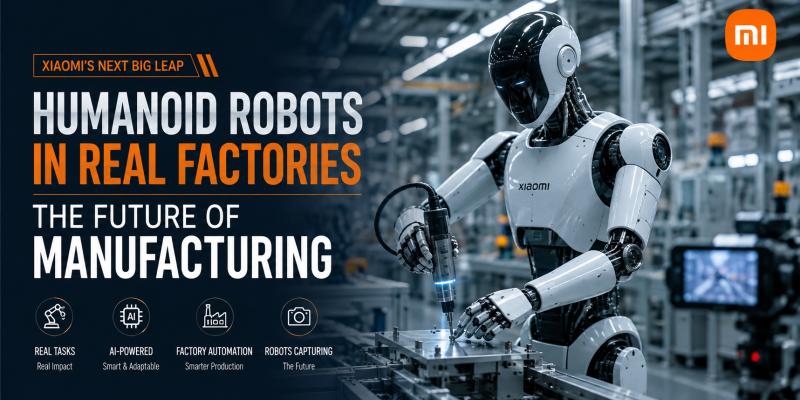
For decades, the idea of humanoid robots working inside factories belonged mostly to science fiction. Robots could weld, lift, sort, inspect and assemble products, but they were usually purpose-built machines designed to perform one specific job.
That is beginning to change.
Xiaomi has now moved its humanoid robotics technology beyond laboratory demonstrations and into a real automotive manufacturing environment. The company has tested humanoid robots inside its EV factory, where they have performed actual assembly tasks autonomously.
And that raises a much bigger question:
Are humanoid robots becoming the next major step in factory automation?
Xiaomi Is Putting Humanoid Robots to Work
Xiaomi is already known for smartphones, consumer electronics and electric vehicles. But the company has increasingly been investing in robotics and artificial intelligence.
In March 2026, Xiaomi revealed that its humanoid robots had entered trial operations at its electric vehicle manufacturing facility. One of the demonstrated tasks involved installing self-tapping nuts at an assembly workstation. The robot reportedly operated autonomously for three continuous hours while performing the task.
According to reports on Xiaomi’s demonstration, the robot achieved a 90.2% success rate on the tested task while working within a 76-second production cycle. The task required the robot to pick components from a feeder and accurately position them for fastening.
This might sound like a relatively simple manufacturing operation.
It isn’t.
For a humanoid robot, the challenge is not simply moving an object from one place to another. The robot must see the component, understand its position, grasp it correctly, align it with the assembly point and execute the movement consistently.
That is where artificial intelligence becomes important.
From Traditional Automation to “Embodied AI”
Traditional industrial robots are extremely effective when a factory environment is predictable.
A robotic arm can be programmed to perform the same movement thousands of times. If the position of a component changes, however, the system may require new programming, additional sensors or mechanical adjustments.
Humanoid robots are being developed with a different objective.
Instead of simply following fixed instructions, they are designed to perceive their surroundings, understand tasks and interact with physical objects.
This approach is often described as embodied AI.
The basic idea is simple:
AI doesn’t just generate an answer on a screen. It controls a machine that can physically interact with the world.
Xiaomi has developed its own vision-language-action technology for this purpose. Its Xiaomi-Robotics-0 model is designed to connect perception, language and physical actions, allowing robots to execute tasks in real-world environments.
The company has continued pushing this technology forward. In July 2026, Xiaomi researchers published details about Xiaomi-Robotics-1, a foundation model trained using more than 100,000 hours of real-world manipulation trajectories.
That development is important because the long-term goal isn’t simply to create a robot that can perform one task.
The goal is to create robots that can learn and adapt to many tasks.
Why Use a Humanoid Robot in a Factory?
A natural question is:
Why build a robot that looks like a human when factories already have robotic arms?
The answer is flexibility.
Modern factories contain thousands of machines and workstations designed around human workers. Tables, shelves, tools, handles, containers and assembly stations are often positioned at human height and designed for human hands.
A humanoid robot can potentially operate in these existing environments without requiring the entire factory to be redesigned.
Instead of building a completely new production system around a robot, manufacturers could eventually deploy robots into environments that already exist.
That could become particularly valuable for:
- Material handling
- Component picking
- Assembly
- Machine tending
- Quality inspection
- Packaging
- Warehouse operations
- Repetitive physical tasks
- Tasks performed in difficult or hazardous environments
The idea is not necessarily to replace every machine already on a production line.
Instead, humanoid robots could fill the gaps between highly specialized automation systems.
The Factory Is Becoming More Autonomous
The most interesting part of this development isn’t necessarily the humanoid robot itself.
It is the larger trend toward increasingly autonomous factories.
Today’s advanced manufacturing facilities already combine:
- Robotic arms
- Automated guided vehicles
- Computer vision
- AI-powered inspection
- Automated material handling
- Digital production monitoring
- Predictive maintenance
- Machine learning
- Industrial software
Xiaomi’s EV factory is an example of this broader transformation. Reporting on the facility describes extensive automation, including hundreds of robotic arms and autonomous systems working across the production process.
Humanoid robots could become another layer in this ecosystem.
Imagine a factory where specialized machines perform precision operations while humanoid robots move between workstations, load components, handle unexpected tasks and assist with processes that are difficult to automate using fixed machinery.
That is a very different manufacturing model from the traditional assembly line.
And Then There Is the Robot Filming the Robot
The social media post that inspired this article highlights another fascinating detail: footage of the humanoid robot’s operation was itself captured using robotic technology.
Whether viewed as a clever demonstration or simply another example of automation, the concept is symbolic of where technology is heading.
Machines are increasingly capable of not only performing physical work but also collecting data, monitoring processes and documenting operations.
In an advanced manufacturing environment, cameras and sensors can continuously monitor production.
AI can analyze that data.
Robots can act on the information.
And automated systems can record the results.
The factory therefore becomes more than a collection of machines. It becomes a connected system capable of sensing, deciding and acting.
Humanoid Robots Still Have a Long Way to Go
It would be easy to look at Xiaomi’s demonstration and conclude that fully autonomous factories staffed by humanoid robots are just around the corner.
Reality is more complicated.
Humanoid robotics is still an emerging technology.
A robot completing one manufacturing task successfully does not mean it can perform hundreds of different jobs reliably. Industrial environments demand extremely high levels of uptime, safety, precision and consistency.
Even a 90% success rate would not be acceptable for many critical production processes without additional safeguards and human oversight.
There are also questions around:
- Robot cost
- Maintenance
- Battery life
- Reliability
- Safety
- Speed
- Training requirements
- Integration with existing factory systems
- Return on investment
For many manufacturing applications, a conventional industrial robot may still be faster, cheaper and more reliable.
Humanoid robots therefore aren’t automatically replacing traditional automation.
They are competing for a different opportunity: general-purpose physical automation.
The Bigger Opportunity: Flexible Automation
The biggest advantage of humanoid robots may eventually be their ability to move from one task to another.
A traditional machine might be designed to perform one operation for ten years.
A sufficiently capable humanoid robot could potentially be retrained or reconfigured to perform another task when production requirements change.
That flexibility could become extremely valuable as manufacturers face shorter product cycles, changing consumer demand and increasing pressure to reduce production costs.
Instead of purchasing a completely different machine for every new task, manufacturers could potentially deploy a general-purpose robotic worker and teach it what to do.
We are not fully there yet.
But companies like Xiaomi are actively working toward it.
What This Means for the Future of Manufacturing
The rise of humanoid robots does not mean factories will suddenly become completely robotic.
The more likely future is a combination of technologies.
Specialized robots will continue performing jobs where they excel.
Humanoid robots may handle more flexible tasks.
AI systems will coordinate production and analyze data.
Computer vision will monitor quality.
Autonomous vehicles will move materials.
Humans will continue supervising, maintaining, designing and improving these systems.
In other words, the factory of the future may not be human versus robot.
It may be humans working alongside increasingly intelligent machines.
From Smartphones to Smart Factories
Xiaomi’s move into humanoid robotics is particularly interesting because the company has already demonstrated how quickly a technology company can expand into completely new industries.
The company moved from consumer electronics into electric vehicles and is now pushing deeper into robotics and embodied AI.
Its humanoid robot experiments show that robotics is moving from research laboratories toward real industrial environments.
That transition is arguably more important than any individual robot demonstration.
Because once robots begin operating in real factories, manufacturers can collect real-world data, identify failures, improve their AI models and gradually expand the range of tasks the machines can perform.
And that creates a feedback loop:
More robots → more real-world data → better AI → more capable robots → more industrial applications.
Are Humanoid Robots the Future?
Maybe not in the exact form we imagine today.
The factory of the future may not be filled with thousands of human-shaped machines walking around.
It may instead contain a mixture of robotic arms, autonomous vehicles, AI systems, vision systems and a smaller number of highly capable humanoid robots handling tasks where flexibility matters most.
But one thing is becoming increasingly clear:
Humanoid robots are no longer purely a science-fiction concept.
Xiaomi’s factory trials demonstrate that these machines are beginning to perform real industrial work under real production conditions. At the same time, the rapid development of AI models designed specifically for physical robots is pushing the technology forward.
The question is no longer simply whether robots can work in factories.
They already can.
The bigger question is:
How much of the factory can eventually be operated by intelligent machines?
And judging by the speed of developments in AI, robotics and manufacturing, we may not have to wait very long to find out.
Final Thought
The most important change may not be that a humanoid robot can install a component.
It is that robots are beginning to combine vision, intelligence, movement and learning in the physical world.
That brings us one step closer to factories where machines don’t just follow instructions.
They understand what needs to be done, perform the task, learn from the result and adapt to what comes next.
The future of manufacturing isn’t arriving all at once.
It’s being assembled, one robotic task at a time.














Comments