

 By
By 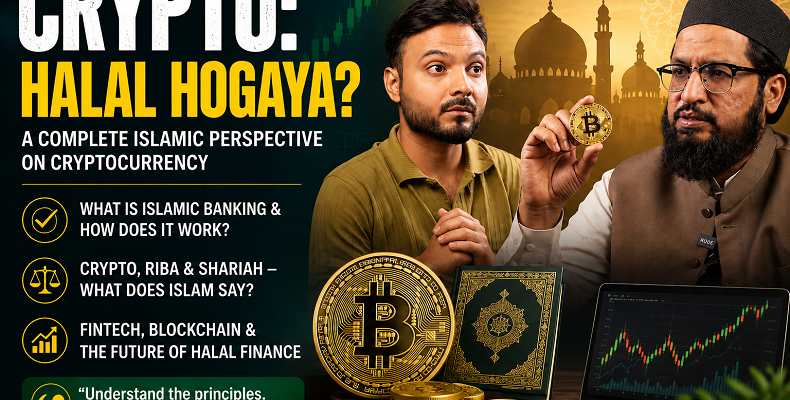
For many Muslims, money is not simply a financial matter. It is also a question of faith.
Whenever a new financial product appears, people naturally want to know: Is it halal? Is it haram? Does it involve riba? Is an Islamic bank genuinely different from a conventional bank, or has the same system simply been given a different name?
These questions become even more complicated when technology enters the picture.
Cryptocurrency, blockchain, digital banking, fintech platforms, Buy Now Pay Later services, smart contracts and AI-powered credit assessment are changing the way people borrow, invest and make payments. At the same time, Islamic finance is trying to keep pace with these changes without compromising its underlying principles.
A recent detailed discussion with Mufti Imran Ashraf Usmani explored many of these questions. The conversation moved far beyond the usual “halal or haram” debate. It looked at how Islamic banking developed, how its financial structures differ from conventional interest-based transactions, why the industry continues to evolve, how crypto should be examined, and what role technology could play in the next generation of Islamic finance.
The discussion also raised a bigger question: Can a modern financial system be both technologically advanced and genuinely Shariah-compliant?
According to the views presented in the discussion, the answer depends on understanding the underlying transaction rather than simply looking at its name.
Why Do People Still Question Islamic Banking?
One of the most common criticisms of Islamic banking is surprisingly simple:
“If I pay more money to an Islamic bank than I borrowed from it, how is that different from interest?”
This question is understandable.
A customer looking at a conventional car loan and an Islamic car-financing product may see similar monthly payments, similar documentation and, sometimes, a similar total amount paid over the life of the arrangement.
That surface-level similarity has led some people to conclude that Islamic banking is simply conventional banking with Arabic terminology.
The discussion strongly challenged that assumption.
The argument presented was that the important difference is not necessarily the final number a customer sees. It is what actually happens in the transaction, what contract is being used, who owns the asset, where the profit comes from, and who carries the associated risk and responsibility.
That distinction becomes important when comparing interest with legitimate trade.
The transcript explains this through the basic principle that Allah has permitted trade while prohibiting riba.
In other words, earning a profit is not automatically the same thing as charging interest.
The source of that profit matters.
Islamic Banking Did Not Appear Overnight
Another important part of the conversation was the history of Islamic banking.
The discussion traced the intellectual foundations of modern Islamic finance back through earlier Islamic scholarship, particularly the work of scholars such as Maulana Ashraf Ali Thanvi and Mufti Muhammad Shafi.
The point was not that modern Islamic banking was invented from nothing in the 1990s. Rather, scholars had been dealing with questions surrounding modern commercial structures, companies, investment instruments and financial transactions for decades.
The challenge was turning those theoretical discussions into a functioning banking system.
According to the discussion, Mufti Taqi Usmani’s work became particularly important in this process. The speaker described his own academic journey through Islamic jurisprudence and financial matters, including extensive research into buying and selling, partnership structures and how Islamic principles could be applied to modern banking.
At one stage, much of this work existed primarily in theory. The real challenge came when scholars and financial professionals had to implement these principles in an actual banking environment.
That transition eventually became associated with the development of Meezan Bank and the broader Islamic banking industry in Pakistan.
From Theory to a Working Islamic Banking System
One of the most interesting parts of the conversation was the description of the early days of Islamic banking.
The speaker recalled starting work with Meezan in the late 1990s, when public understanding of Islamic banking was still limited. At that point, Pakistan did not have a complete Islamic alternative covering the entire range of commercial banking services.
A modern bank needs to do much more than simply provide loans.
It needs deposits, savings products, current accounts, trade finance, working-capital facilities, consumer finance, corporate finance, housing finance and many other services.
The challenge was to build structures for all of these activities while keeping them within the principles of Islamic jurisprudence.
That required more than changing the terminology on banking documents.
It required designing actual contracts and processes.
The Difference Between Interest and Trade
This is probably the most important concept discussed in the entire conversation.
Suppose someone lends another person Rs. 1 million and requires Rs. 1.1 million to be returned simply because time has passed.
The additional Rs. 100,000 is tied directly to the loan.
That is fundamentally different from buying an asset and selling it at a profit.
In a genuine sale, the seller owns an asset, takes responsibility associated with ownership and then sells that asset to the buyer.
The discussion repeatedly returned to this concept of ownership, risk and reward.
The speaker explained that a transaction cannot simply be structured to generate a return while removing every responsibility associated with ownership. The legitimacy of a transaction depends on its underlying structure.
The transcript uses examples involving leasing and purchasing assets to illustrate the difference.
This is why terms such as Murabaha, Musharakah, Mudarabah and Ijarah matter in Islamic finance.
They are not supposed to be decorative labels. They represent different contractual relationships.
What Is Murabaha?
Murabaha is essentially a cost-plus sale structure.
Rather than simply lending cash and charging interest on that cash, the transaction is structured around the purchase and resale of an asset.
For example, imagine a customer needs a piece of equipment.
Under a conventional interest-based loan, the bank may provide the money and charge interest over time.
Under a properly structured Murabaha transaction, the financial institution purchases the identified asset and then sells it to the customer at a disclosed cost plus an agreed profit.
The customer may pay that sale price over installments.
From the customer’s perspective, both arrangements involve monthly payments.
But the underlying contracts are different.
That underlying difference is the point Islamic finance places emphasis on.
Musharakah and Mudarabah: Partnership Instead of Guaranteed Interest
The conversation also discussed partnership-based structures.
In Musharakah, parties contribute capital to a partnership and share the results according to an agreed arrangement, with losses generally connected to the partners’ respective capital contributions.
In Mudarabah, one party provides capital while another manages the business or investment activity, with profits shared according to an agreed ratio and losses treated according to the rules of the arrangement.
These structures are fundamentally different from a simple loan where the lender expects a predetermined return regardless of the performance of the underlying activity.
The early Islamic banking experience described in the discussion included the development of a Musharakah-based “Riba Free Certificate.” The speaker recalled that the product attracted significant investment shortly after its introduction, illustrating the strong demand that existed for alternatives to conventional interest-based products.
Why Were Islamic Banking Products Sometimes More Expensive?
This is another criticism that many customers raise.
If Islamic banking is supposed to be an alternative, why did some Islamic products historically appear more expensive than conventional alternatives?
The discussion offered a practical explanation.
In the early years, there were relatively few Islamic financial institutions, limited infrastructure and a shortage of trained professionals.
Building a new financial system costs money.
There were also fewer competitors.
As more Islamic banks and Islamic banking windows entered the market, competition increased. The discussion compared this to any other marketplace: when there is only one supplier, pricing dynamics can be very different from a market where several competitors offer similar products.
This is an important distinction because people sometimes compare today’s mature Islamic banking industry with its earliest years without considering how dramatically the market has changed.
Are Islamic Windows in Conventional Banks Really Islamic?
Another major question raised in the conversation concerned Islamic banking windows.
Many conventional banks now offer Islamic banking divisions or windows.
The obvious question is:
“Is this genuinely Islamic banking, or is it just conventional banking under another name?”
The discussion’s answer was that Islamic banking windows can operate within the same broader regulatory environment while using Shariah-compliant structures and controls.
The State Bank of Pakistan has developed a regulatory framework for Islamic banking, including Shariah governance and oversight mechanisms. The discussion described the role of Shariah boards, audits and regulatory supervision in maintaining the required standards.
That does not mean every institution should be trusted blindly.
It means the actual product and its structure need to be examined rather than judging it simply by the fact that it operates inside a conventional banking group.
The Role of the State Bank
The conversation also highlighted an often-overlooked issue: Islamic banks do not operate in a completely separate universe.
They operate inside the national financial system.
That creates practical challenges.
A central bank performs multiple functions. Commercial banks may need liquidity facilities, maintain reserves and interact with the central banking system.
The discussion described efforts to create Shariah-compliant mechanisms for Islamic banks within this broader environment, including separate arrangements for deposits and liquidity management.
The larger objective discussed was eventually moving the country’s financial system toward greater compliance with Islamic principles.
Is Pakistan Serious About Eliminating Interest?
This became one of the most significant questions toward the end of the conversation.
The discussion referred to the goal of eliminating interest from Pakistan’s financial system by 2028 and asked whether this was actually achievable or merely another promise.
The response was optimistic.
The speaker said work was already underway and pointed to developments such as Sukuk, including shorter-term Sukuk structures intended to serve functions traditionally associated with government securities.
The conversation also mentioned newer areas such as Green Sukuk, ESG-related financing and other forms of Shariah-compliant financial instruments.
Whether the broader transition ultimately happens exactly as discussed is a matter for policymakers, regulators and the future.
But the conversation’s central message was clear: Islamic finance cannot remain limited to traditional banking products. It needs a complete financial ecosystem.
And that brings us to technology.
Crypto: Is Cryptocurrency Automatically Haram?
Few topics generated as much controversy in the discussion as cryptocurrency.
A viral fatwa had circulated widely, creating the impression among many viewers that cryptocurrency had simply been declared haram in every form.
The conversation provided a more complicated picture.
The speaker explained that the document being circulated was an older response to a specific question and that its wording and context had been widely misunderstood after being circulated online.
He then described an ongoing research process examining cryptocurrency from multiple angles rather than treating every form of crypto as identical.
This distinction is important.
“Crypto” is a broad term.
Blockchain is a technology.
A cryptocurrency is one possible application of that technology.
Tokenization is another.
NFTs can be another.
Smart contracts can be another.
Therefore, judging the entire technology based on one application may not make sense.
Blockchain Is a Technology, Not a Financial Ruling
One of the strongest points made during the crypto discussion was that blockchain itself is simply a technology.
The speaker compared it to a digital ledger — a system for recording information and transactions.
What matters is what is built on top of it.
A blockchain can support different types of applications. Some may be legitimate, some may be questionable and others may potentially be used for prohibited activities.
The transcript specifically discusses tokenization, smart contracts, NFTs and digital representations of assets.
This creates an important framework for understanding future Islamic finance:
Technology itself does not necessarily determine whether a financial transaction is permissible. The underlying use and structure matter.
Can a Digital Token Represent a Real Asset?
The discussion went one step further.
Suppose a digital token genuinely represents ownership in a tangible asset such as gold, silver, property or another Shariah-recognized asset.
That is very different from a token that has no underlying asset or ownership interest.
The speaker explained that if a token genuinely represents an underlying asset and the holder has a corresponding ownership interest, it may need to be evaluated as an asset rather than simply dismissed because it is digital.
The same concept can apply to digital shares and digitally issued Sukuk.
A paper certificate can become a digital certificate without necessarily changing the underlying ownership represented by it.
This is where the crypto debate becomes much more technical.
Stablecoins and Non-Stablecoins
The conversation also distinguished between different types of cryptocurrency.
A stablecoin may be designed to maintain a relationship with an underlying asset or value.
But the word “stable” by itself does not automatically make a cryptocurrency Shariah-compliant.
The real question is:
What exactly is behind the token?
Does it represent an actual asset?
Does the holder have ownership?
Is it merely a claim or receivable?
Is there only a guarantee?
Is it backed by cash?
These distinctions can materially change the Shariah analysis.
The discussion acknowledged that these issues are technical and require specialists with expertise in both Islamic jurisprudence and modern financial systems.
That is perhaps one of the most sensible lessons from the entire crypto discussion: not every financial question can be answered responsibly with a simple social-media headline.
Why Scholars Need to Understand Technology
The world of finance is changing too quickly for Islamic scholarship to remain disconnected from technology.
Blockchain, artificial intelligence, digital wallets, tokenization, fintech platforms and online marketplaces are becoming part of everyday commerce.
The discussion argued that Muslim scholars need to understand these technologies properly before issuing judgments about them.
At the same time, technology professionals and financial institutions need to understand Shariah principles instead of simply attaching the word “Islamic” to a product.
That requires collaboration.
A modern Islamic financial product may need input from:
- Shariah scholars
- Financial institutions
- Regulators
- Lawyers
- Technology specialists
- Economists
- Business owners
- Customers
The discussion specifically emphasized that financial products should not simply be created and marketed without considering their practical, regulatory and Shariah implications.
Islamic Finance and the Future of Fintech
Perhaps the most forward-looking section of the conversation concerned fintech.
Traditional banking required branches.
Customers visited a bank, filled out forms, provided documents, signed agreements and waited for financing decisions.
That model is rapidly changing.
Today, a customer can potentially be onboarded digitally, verified electronically and assessed using large amounts of data.
The discussion described how information such as income, utility payments, credit history and other financial behavior can contribute to automated credit assessment.
Artificial intelligence can then help financial institutions determine how much financing a customer may be able to handle.
This could have major implications for small businesses.
Why SMEs Could Benefit From Digital Islamic Finance
Small and medium-sized businesses often struggle to access bank financing.
They may have limited collateral.
Their documentation may not be perfect.
They may operate partly in cash.
They may not have the financial history that traditional banks require.
As a result, a large part of the economy can remain outside formal financial services.
The discussion suggested that data-driven credit assessment could help change this.
Instead of relying exclusively on property as collateral, financial institutions could potentially build a more complete picture of an individual’s or business’s financial capacity.
This could open financing opportunities to businesses that were previously excluded.
But again, technology alone is not enough.
The financing structure itself still needs to meet the applicable legal, regulatory and Shariah requirements.
Smart Contracts Could Make Islamic Finance More Efficient
Another fascinating possibility is the use of smart contracts.
The speaker recalled that early Islamic finance transactions could involve lengthy contracts and significant paperwork.
Today, blockchain-based systems and smart contracts could potentially automate parts of the process.
Instead of relying on dozens of pages of manually executed documentation, a digital system can encode the agreed transaction conditions and automatically execute predefined steps.
The discussion suggested that this could reduce errors, simplify audits and make complex financial transactions much faster.
Imagine a future where a business owner purchases inventory through a digital marketplace.
The marketplace identifies the supplier.
A fintech platform verifies the business.
An Islamic financial institution provides the required financing.
The underlying contract is digitally executed.
Payment terms are automatically recorded.
The transaction is audited digitally.
And the entire process takes minutes rather than days.
That is the kind of financial ecosystem the discussion envisioned.
Buy Now, Pay Later and Islamic Finance
Buy Now, Pay Later services have also changed consumer finance.
But the same question applies:
Is the financing based on an actual sale or lease, or is it effectively a cash loan with interest and penalties?
The discussion suggested that Islamic fintech could potentially provide alternative structures using established contracts such as Murabaha and Ijarah.
For example, a merchant may need financing to purchase inventory from a supplier. Instead of receiving an interest-bearing cash loan, the transaction could potentially be structured around the purchase and sale of the underlying goods.
The transcript specifically discusses B2B and B2C marketplaces and the possibility of integrating Islamic financing directly into digital commerce platforms.
This could become an important area for Islamic fintech.
The Human Cost of Interest and Predatory Lending
The discussion eventually moved from financial structures to something much more human: poverty.
For someone with substantial financial resources, a financing decision can be a business calculation.
For someone living on the edge, borrowing can be a matter of survival.
The conversation highlighted the danger of desperate borrowers turning to informal lenders when they cannot access formal financial institutions.
High-cost debt can trap already vulnerable families in a cycle where one loan is used to repay another.
The discussion therefore argued that Islamic finance should not only focus on avoiding riba technically. It should also consider ethics and the social consequences of financial decisions.
The speaker summarized the broader responsibility around three considerations:
Shariah, government regulation and ethics.
All three matter.
That is an important point because a financial product can be technically structured in a particular way while still raising serious questions about fairness, accessibility or exploitation.
Islamic Banking Should Reach Small Businesses, Not Just Large Corporations
Another major theme was wealth distribution.
The discussion argued that Islamic finance should not become a system that serves only large corporations and wealthy customers.
Small businesses are a major part of the economy, particularly in countries such as Pakistan.
Yet many small traders struggle to obtain formal financing because they lack collateral, documentation or conventional credit histories.
Digital finance could potentially change that.
Instead of asking only, “What property can you pledge?”, financial institutions may increasingly ask:
“What does the data tell us about this business?”
That shift could make financing more accessible.
The transcript specifically discusses how AI-powered credit assessment and digital banking could reduce reliance on traditional collateral and expand financial access.
What About YouTube Advertising?
The conversation even reached an unusual question: Is YouTube advertising income halal?
The question was framed around a creator who produces permissible content but cannot completely control which advertisements YouTube displays.
The discussion recognized that modern advertising systems are algorithmic and that the creator may not personally select every advertisement shown to every viewer.
It also emphasized the importance of the content itself and the broader context in which monetization takes place.
This is another example of how digital platforms create questions that earlier generations of scholars simply did not have to address.
And it shows why Islamic jurisprudence needs continuous engagement with new technologies.
Islamic Finance Is Still a Work in Progress
One of the most balanced points in the conversation was that Islamic banking should not be treated as a finished product.
Even after decades of development, there is still room for improvement.
The objective should not simply be to replace the word “interest” with another word.
The larger objective is to create a financial system that operates within Shariah principles while also being practical, competitive, transparent and socially responsible.
That means continuing to examine:
- How wealth is distributed
- How financing reaches SMEs
- How customers are treated
- How digital finance is regulated
- How fintech products are structured
- How crypto and tokenization should be evaluated
- How technology can reduce fraud and errors
- How financial inclusion can be expanded
- How Islamic finance can compete globally
The discussion’s message was essentially that the work does not stop when a product receives a Shariah ruling.
The financial world continues to change, so the research must continue as well.
The Future May Be Islamic Fintech, Not Traditional Islamic Banking
Perhaps the biggest takeaway from the conversation is that the future of Islamic finance may look very different from the Islamic banking model people know today.
Tomorrow’s customer may not walk into a bank branch.
They may buy a product through an online marketplace.
The financing option may appear automatically at checkout.
A digital system may assess their eligibility within seconds.
A smart contract may execute the transaction.
The underlying asset may be digitally represented.
The payment schedule may be automated.
And the entire process may happen without the customer ever physically visiting a bank.
The question for Islamic finance is therefore not whether technology should be accepted.
The more important question is:
How can technology be used to build financial products that are efficient, transparent, accessible and genuinely compliant with Islamic principles?
The conversation suggests that Muslims should not simply stand outside technological development and wait to see what happens.
They should understand the technology, participate in its development and identify where it can be used beneficially.
A More Mature Way to Ask “Halal or Haram”
Perhaps the most valuable lesson from the discussion is that financial questions deserve more than one-word answers.
When someone asks whether a product is halal or haram, several additional questions may need to be asked:
What exactly is being bought or sold?
Who owns the asset?
Where does the profit come from?
Who carries the risk?
What contract governs the transaction?
Is there an underlying asset?
Is the transaction genuinely taking place or is the structure merely disguising another type of transaction?
What does the law say?
How does the product work in practice?
Could it cause harm or exploitation?
These questions become even more important when dealing with new technologies.
A cryptocurrency is not necessarily identical to another cryptocurrency.
A digital token is not necessarily identical to another token.
A fintech loan is not necessarily identical to another fintech loan.
And an Islamic banking product cannot be judged solely by its monthly installment.
Final Thoughts
The conversation about Islamic banking, crypto and fintech ultimately became a conversation about something much bigger: how Islamic principles can remain relevant in a rapidly changing financial world.
Islamic banking has come a long way from being largely theoretical to becoming a significant part of the global financial industry. The discussion described how scholars, regulators and financial professionals worked to turn traditional principles into functioning banking products and regulatory frameworks.
But the next challenge may be even bigger.
Blockchain is changing ownership records.
Artificial intelligence is changing credit assessment.
Fintech is changing banking.
Digital marketplaces are changing commerce.
Smart contracts are changing how agreements can be executed.
Cryptocurrency and tokenization are challenging traditional definitions of money and assets.
Islamic finance will have to engage with all of these developments.
The answer should not be to accept every new technology without question.
Nor should it be to reject something simply because it is new.
The more responsible approach is to understand it first, investigate it carefully, examine its real-world consequences and then determine how — or whether — it can be used within Islamic principles.
That was perhaps the strongest message running through the entire discussion: knowledge has to keep moving forward.
The financial system of tomorrow will not look exactly like the financial system of yesterday.
If Islamic finance wants to remain relevant, it will need to evolve with it — without losing sight of the principles on which it is built.
And that may ultimately be where Islamic banking, fintech and technology meet: not in simply giving old products new names, but in creating a genuinely modern financial ecosystem built around transparency, responsibility, shared value and Shariah principles.





Comments