

 By
By 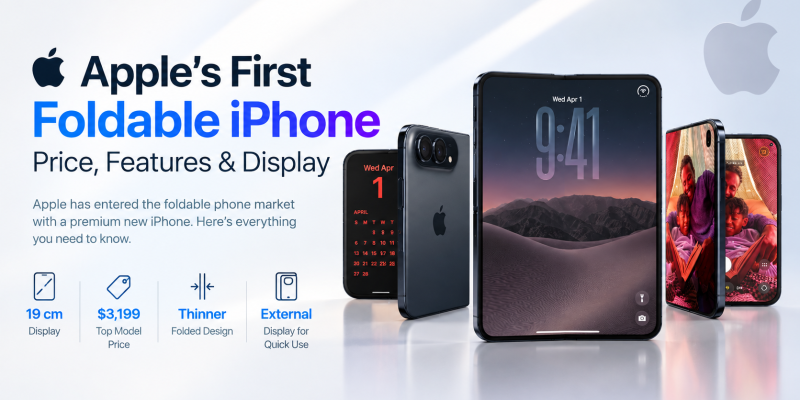
Apple has finally stepped into the foldable smartphone market, introducing its first-ever foldable iPhone and marking a major change in the company’s long-running iPhone design strategy.
For years, Samsung, Google and several other smartphone manufacturers have experimented with foldable devices. Apple, however, stayed away from the category while the technology continued to develop.
That changed with the launch of Apple’s first foldable iPhone.
According to the information in the original report, the top version of the new foldable iPhone carries a price tag of $3,199, making it Apple’s most expensive iPhone to date. The price alone puts the device firmly into the premium segment and makes the new iPhone a particularly interesting product to watch.
Apple’s First Foldable iPhone Arrives
The arrival of a foldable iPhone has been anticipated for years. Apple has traditionally taken a cautious approach to new hardware categories, often entering markets after competing technologies have had time to mature.
Foldable smartphones are no longer a niche experiment. Manufacturers have released several generations of foldable devices, with improvements in screen durability, hinges, software and overall design.
Apple’s entry therefore represents more than another iPhone launch. It signals that foldable phones have become an important enough part of the premium smartphone market for Apple to participate.
The new device reportedly combines the familiar iPhone experience with a folding form factor that allows users to access a larger display when the phone is opened.
A Large 19-Centimeter Display
One of the key features highlighted in the report is the phone’s 19-centimeter display.
The screen has rounded edges and can be used in both portrait and landscape orientations. That flexibility could make the foldable format useful for people who frequently switch between different types of content.
A larger display can be particularly useful for watching videos, browsing websites, reading documents, viewing photos and working with multiple applications.
When the phone is folded, users can rely on a smaller external display for everyday tasks without having to open the device completely.
That creates two different ways of using the same smartphone: a compact format for quick interactions and a larger screen for activities that benefit from additional space.
One Phone, Two Different Experiences
The biggest appeal of a foldable smartphone is not simply the ability to fold it.
The real advantage is the possibility of carrying a relatively compact device while still having access to a much larger display when needed.
For example, someone checking notifications or replying to a quick message may prefer the phone in its folded state. Opening it could provide a more comfortable experience for watching a video, browsing social media or reading longer content.
This approach has helped define the foldable smartphone category over the past several years.
Apple’s challenge will be to make that transition feel natural rather than turning the foldable design into a novelty feature.
Apple’s Focus on Thinness
Apple is also highlighting the device’s thin design.
According to the report, the foldable iPhone is Apple’s thinnest iPhone when fully opened.
Thickness has always been an important factor in foldable smartphone design. Manufacturers have to accommodate a flexible display, hinge mechanism and other components while keeping the device comfortable to carry.
A thinner unfolded design could therefore be an important part of Apple’s approach to the category.
For users, however, thinness is only one part of the equation. Durability, battery life, hinge reliability, camera performance and software optimization will also determine whether the design works well in everyday use.
The $3,199 Price Tag
The biggest talking point surrounding the new device may be its price.
At $3,199 for the top version, the foldable iPhone sits far above the price of conventional flagship smartphones.
That makes the product less of an ordinary iPhone upgrade and more of a premium technology purchase.
Apple has already established a high-end market for its most expensive iPhone models, but a foldable design introduces another level of hardware complexity.
The question for consumers will be whether the larger display and new form factor justify the significant price difference.
For Apple, the pricing also creates an interesting market position. The company is not simply competing with traditional smartphones; it is entering a category where consumers have already seen premium foldable devices from established competitors.
Apple Is Late to the Foldable Phone Market
Apple’s entrance into the foldable market comes after several other smartphone manufacturers have already released foldable products.
Samsung, in particular, has spent years developing its Galaxy Z Fold and Galaxy Z Flip lines. Other manufacturers have also introduced their own foldable designs.
This means Apple is not entering an empty market.
Instead, it is entering a category where consumers already have expectations about screen quality, hinge design, durability, multitasking and battery performance.
That could actually make Apple’s launch more interesting.
Rather than convincing consumers that foldable phones are possible, Apple now has to convince them that its version offers something compelling enough to choose over existing alternatives.
A Major Test for Apple’s New Leadership
The launch also comes at an important time for Apple leadership.
The transcript describes Apple’s new CEO as John Tern, although this name appears to be a transcription error and should be verified against the original video before publication.
Regardless of the exact name, the foldable iPhone represents a significant test for Apple’s leadership and product strategy.
The iPhone remains one of the company’s most important products, so introducing a completely different form factor carries considerable expectations.
A successful foldable iPhone could establish a new premium product category for Apple. On the other hand, the extremely high price means the device will initially appeal to a relatively limited group of consumers.
Will People Pay More for a Foldable iPhone?
This is likely to become one of the biggest questions surrounding Apple’s new device.
Consumers already have access to powerful smartphones with large displays. A foldable iPhone therefore needs to provide more than a different physical shape.
The benefits need to be noticeable in everyday use.
A foldable design could be useful for people who consume a lot of media, work from their phones, travel frequently or want a larger screen without carrying a traditional tablet.
But for someone who primarily uses a phone for messaging, calls, social media and photography, paying thousands of dollars for a foldable design may be harder to justify.
That distinction could determine who Apple’s first foldable iPhone is actually designed for.
The Foldable iPhone Could Change Apple’s Product Strategy
Apple’s decision to enter the foldable market could have implications beyond this particular device.
If consumers respond positively, Apple could eventually expand its foldable technology into additional products and price ranges.
The company could also use feedback from this first-generation device to improve future models.
This is how many new smartphone categories develop. The first generation establishes the concept, while later generations refine the design, reduce thickness, improve durability and potentially become more affordable.
For Apple, the first foldable iPhone could therefore be less about selling huge numbers immediately and more about establishing a new direction for the iPhone family.
What Makes the Launch Significant?
The importance of the foldable iPhone goes beyond its screen.
Apple has avoided the foldable category while competitors have spent years developing it. Its arrival could bring much more attention to foldable smartphones among mainstream consumers.
Millions of people who previously had little interest in foldable phones may now start considering the technology simply because Apple has entered the market.
That could increase competition and push manufacturers to improve their own designs.
It could also accelerate innovation around flexible displays, hinges, batteries and mobile software.
The Bigger Picture for Smartphones
The smartphone industry has spent years looking for ways to make devices more useful without making them significantly larger.
Foldable technology offers one possible solution.
Instead of carrying a large phone all the time, users can carry a smaller device and open it when they need more screen space.
Apple’s entry gives that concept a new level of visibility.
Whether the foldable iPhone becomes a mainstream success or remains a high-end product for enthusiasts will depend on several factors, including price, durability, software experience, battery life and how useful the larger display proves to be.
Final Thoughts
Apple’s first foldable iPhone represents one of the company’s biggest changes to the traditional iPhone design in years.
With a reported $3,199 price tag for the top model, a 19-centimeter display, a smaller external screen and an emphasis on a thin unfolded design, Apple is positioning the device firmly at the premium end of the smartphone market.
The company may be entering the foldable market later than some of its competitors, but Apple’s enormous influence over the smartphone industry means this launch could still have a significant impact.
The bigger question is not simply whether Apple can make a foldable iPhone.
It is whether consumers will decide that a foldable iPhone is worth paying a premium for.
As foldable smartphones continue to evolve, Apple’s first entry could become an important milestone in the next chapter of smartphone design.
Frequently Asked Questions
When did Apple launch its first foldable iPhone?
According to the provided report, Apple has introduced its first-ever foldable iPhone as part of its latest product launch.
How much does the foldable iPhone cost?
The top version mentioned in the report is priced at $3,199.
How large is the foldable iPhone’s display?
The report describes a display measuring approximately 19 centimeters.
Can the foldable iPhone be used when closed?
Yes. The report says the device has a smaller external display that can be used while the phone is folded.
Why is Apple’s foldable iPhone important?
It marks Apple’s entry into a smartphone category that other manufacturers have already been developing for several years.
Is the foldable iPhone Apple’s most expensive iPhone?
According to the provided transcript, the $3,199 top-end version makes it the company’s most expensive iPhone to date.
What will determine whether the foldable iPhone succeeds?
Factors such as pricing, durability, battery life, software optimization, display quality and the usefulness of the foldable design will all influence consumer response.













Comments