

 By
By 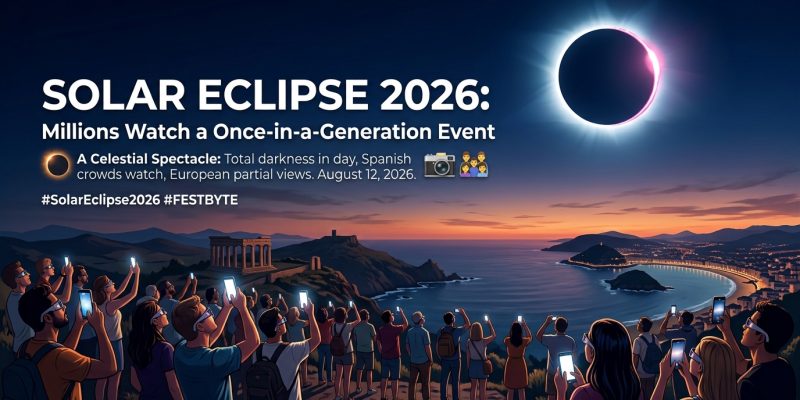
From the mountains of Spain to the shores of the UK, all eyes turned skyward for a celestial spectacle few living people will ever see twice.
On August 12, 2026, the sky did something it hasn’t done over this stretch of Europe in more than a century — it went dark in the middle of the day. A total solar eclipse swept down from the Arctic, crossed Greenland and Iceland, and carved a narrow path across northern Spain, ending in a dramatic sunset eclipse over the Balearic Islands. For the millions who gathered to watch, it was the astronomical event of a lifetime.
A Path Written in the Stars
The eclipse’s journey was almost cinematic in scope. It began high over the North Pole, swept down the eastern coast of Greenland, brushed the northwest tip of Iceland, crossed open ocean, and finally reached Spain — arriving just as the sun dipped toward the horizon. For Spain, this wasn’t just rare; it was historic. The country hadn’t experienced a total solar eclipse since 1905.
Iceland’s turn in the spotlight was even rarer still — astronomers note the island won’t see another total eclipse for the rest of the century.
Crowds, Cheers, and a Sky Full of Phones
In towns like Medinaceli, a hilltop settlement steeped in Roman history, crowds arrived early with lawn chairs and umbrellas, staking out the best patch of sky. As totality approached and the light began to fade — first gradually, then all at once — applause rippled through the crowds. In some places, clouds threatened to spoil the moment, but when darkness finally fell, phone screens lit up the crowd like a field of fireflies, held aloft to capture what words struggle to describe.
Not everyone got a clear view. Weather along the path was famously unpredictable this year, and some eclipse-chasers who traveled thousands of miles were met with cloud cover at the critical moment — a reminder that even the most precisely calculated celestial event still bows to something as ordinary as the weather.
Not Just Spain: A Continent Looked Up
While totality was reserved for a narrow band through Greenland, Iceland, and Spain, a partial eclipse was visible across much of Europe — and beyond. In the UK, spectators along Liverpool Bay and Crosby Beach watched the sun take on a crescent shape. In Munich, families climbed the Olympiaberg for a better vantage point. In Kraków, one resourceful spectator improvised with a kitchen colander, letting sunlight filter through its holes to cast dozens of tiny crescent shadows onto a sheet of paper — a simple trick that turned into one of the eclipse’s more charming images.
Even parts of North America and northern Africa caught a glimpse of the partial phase, making this genuinely a shared, global moment.
An Economy Built Around a Shadow
The eclipse wasn’t just a scientific curiosity — it was an economic event. Spanish authorities estimated it drew at least half a million extra visitors to the country, and hotel demand along the path of totality — in cities like A Coruña, Bilbao, and Santiago de Compostela — surged for months beforehand. Supermarkets, museums, and planetariums had spent the run-up to the eclipse handing out or selling protective glasses, anticipating a spike in interest that, in the end, more than delivered.
Tour operators built entire itineraries around the two or three minutes of darkness, pairing eclipse-watching with visits to landmarks like Bilbao’s Guggenheim Museum and Madrid’s Prado, turning a brief astronomical event into a week-long cultural pilgrimage for travelers from around the world.
Why It Mattered
Total solar eclipses are studies in scarcity. Any single point on Earth waits an average of 375 years between them. For places like Spain and Iceland, this wasn’t a once-in-a-decade event — it was closer to once-in-a-lifetime, and in Iceland’s case, once-in-several-lifetimes.
That scarcity is exactly what pulled so many people outdoors on a Wednesday afternoon to stare, safely, at the sky. It’s rare that an entire continent pauses at the same moment to look up — but for a few minutes in August 2026, that’s exactly what happened.
Next up on the eclipse calendar: August 2, 2027, when totality sweeps across northern Africa, Gibraltar, and the Arabian Peninsula. The UK, meanwhile, will have to wait until 2090 for its next total eclipse.













Comments