

 By
By 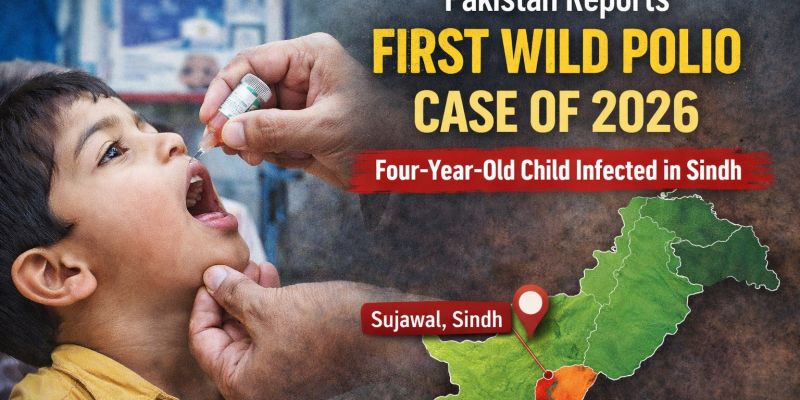
Pakistan has reported its first wild poliovirus case of 2026, health authorities confirmed on Thursday. The case involves a four-year-old child from Bello Union Council in Sujawal district, Sindh, raising renewed concerns about the continued presence of the virus in certain parts of the country.
According to officials from the National Emergency Operations Centre (NEOC) for Polio Eradication, the case was identified through Pakistan’s nationwide disease surveillance system. Laboratory testing conducted at the Regional Reference Laboratory for Polio Eradication at the National Institute of Health (NIH) in Islamabad later confirmed the presence of the wild poliovirus.
Authorities Respond to Contain the Virus
The Polio Eradication Initiative (PEI) said it is currently evaluating the most effective response measures to stop the spread of the virus and protect children in nearby communities. Health teams are expected to strengthen vaccination and monitoring efforts in the affected region to prevent further transmission.
Despite this new case, officials note that Pakistan has made significant progress in reducing polio infections over the past three decades. Since the introduction of widespread vaccination campaigns in the 1990s, the country has seen a 99.8% decline in polio cases, dropping from an estimated 20,000 annual cases in the early 1990s to 31 reported cases in 2025.
Nationwide Vaccination Campaigns Continue
Pakistan’s anti-polio programme continues to run large-scale immunization drives across the country. In 2026, authorities have already conducted a nationwide campaign reaching more than 45 million children, with another national vaccination round scheduled for April.
During 2025, the Polio Eradication Initiative organized five nationwide vaccination campaigns, along with additional targeted immunization drives. These efforts included both oral and injectable polio vaccines and were integrated with routine childhood immunization programmes.
High-Risk Areas Still Require Attention
Health experts say that although virus detection has declined compared with 2024, poliovirus transmission still exists in certain high-risk areas. Some districts in Sindh and southern Khyber Pakhtunkhwa (KP) remain vulnerable due to gaps in vaccination coverage and population movement.
Officials stress that continued surveillance and targeted vaccination campaigns are essential to fully eliminate the virus from Pakistan.
Polio Remains a Serious Health Threat
Polio is a highly contagious viral disease that can lead to permanent paralysis and, in severe cases, death. While there is no cure, it can be effectively prevented through vaccination. Polio vaccines have been used safely for decades in more than 195 countries, including across the Muslim world.
Importance of Vaccination
Health authorities emphasize that eradicating polio requires collective effort. While frontline health workers travel to remote areas to vaccinate children, parents and caregivers play a critical role by ensuring their children receive every recommended dose.
The Polio Eradication Initiative urges families to participate in each vaccination campaign so that every child remains protected from lifelong disability.
Working Toward a Polio-Free Pakistan
Community leaders, religious scholars, and media organizations are also encouraged to help promote accurate information about vaccination and combat misinformation.
With sustained vaccination campaigns and strong community support, health officials believe Pakistan can achieve the long-standing goal of becoming polio-free, protecting future generations from the disease.









Comments