

 By
By 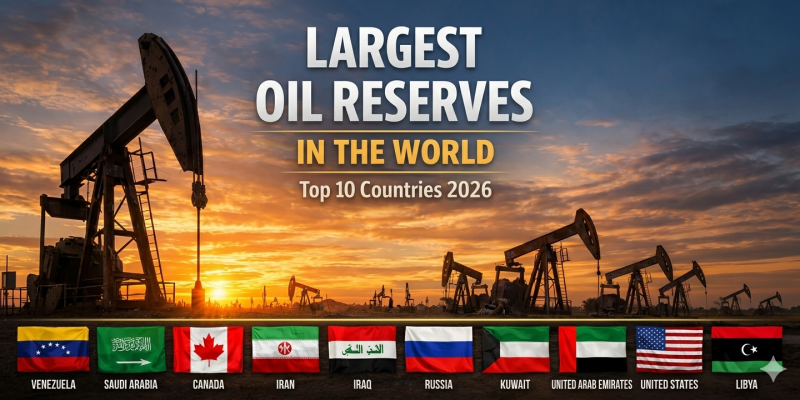
Oil continues to play a major role in the global economy. It fuels transportation, powers industries, and remains one of the most valuable natural resources worldwide. Even as renewable energy grows, countries with large oil reserves still hold significant economic and political influence.
In this guide, we’ll look at the top countries with the largest oil reserves in 2026 and understand why they matter in the global energy landscape.
What Are Proven Oil Reserves?
Proven oil reserves refer to the amount of crude oil that can be extracted using current technology under existing economic conditions. It’s not just about how much oil exists underground, but how much can actually be recovered and used profitably.
Top 10 Countries with the Most Oil Reserves
1. Venezuela – ~303 Billion Barrels
Venezuela holds the largest oil reserves in the world, estimated at around 303 billion barrels. Most of this oil is heavy crude located in the Orinoco Belt, which makes extraction more complex and expensive. Despite its vast reserves, production has been limited due to economic and political challenges.
2. Saudi Arabia – ~267 Billion Barrels
Saudi Arabia comes next with approximately 267 billion barrels. It is one of the most influential oil-producing nations because its oil is relatively easy and cost-effective to extract. The country plays a key role in global oil pricing and supply.
3. Canada – ~168 Billion Barrels
Canada ranks third with around 168 billion barrels, largely found in oil sands. While the reserves are massive, extracting oil from sands is expensive and raises environmental concerns.
4. Iran – ~157 Billion Barrels
Iran has about 157 billion barrels of oil reserves. It has significant potential, but international sanctions have restricted its ability to fully participate in global oil markets.
5. Iraq – ~145 Billion Barrels
Iraq holds approximately 145 billion barrels and is known for having some of the easiest and cheapest oil to extract. However, political instability has affected its ability to maximize production.
6. Russia – ~107 Billion Barrels
Russia, with around 107 billion barrels, is a major global energy supplier. It plays a crucial role in providing oil to Europe and Asia, giving it strong geopolitical influence.
7. Kuwait – ~101 Billion Barrels
Kuwait has about 101 billion barrels of oil reserves. Despite its small size, oil is the backbone of its economy and a major contributor to its wealth.
8. United Arab Emirates – ~98 Billion Barrels
The United Arab Emirates holds roughly 98 billion barrels. While oil remains important, the country has also focused on diversifying its economy and investing in future energy solutions.
9. United States – ~69 Billion Barrels
The United States has around 69 billion barrels of proven reserves. Although it does not top the list in reserves, it is the world’s leading oil producer due to advanced technologies like shale extraction.
10. Libya – ~48 Billion Barrels
Libya rounds out the list with approximately 48 billion barrels. It has the largest oil reserves in Africa, but production is often disrupted due to political instability.
Why Oil Reserves Matter
Countries with large oil reserves have a significant advantage in the global economy. They can influence oil prices, control energy supply, and maintain strong political power. Oil exports also contribute heavily to national income in many of these countries.
However, having large reserves does not always guarantee success. Challenges such as high extraction costs, sanctions, and unstable political environments can limit a country’s ability to benefit fully from its resources.
The Future of Oil
While oil remains essential today, the global energy landscape is gradually changing. Renewable energy sources like solar and wind power are becoming more popular, and electric vehicles are reducing dependence on fossil fuels.
Even so, oil is expected to remain a key part of the energy mix for many years to come.
Final Thoughts
The countries with the largest oil reserves continue to shape global energy markets and influence international politics. However, the future will depend not only on how much oil a country has, but also on how effectively it can adapt to a changing energy environment.







Comments