
 By
By 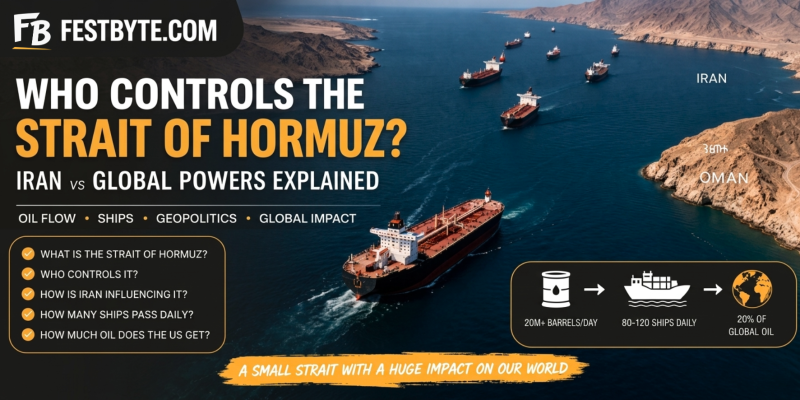
The Strait of Hormuz is one of the most critical and sensitive locations in the world. It is not just a narrow passage of water but a global economic lifeline, a geopolitical hotspot, and a strategic point of control between regional and global powers.
Many people search for answers to key questions such as what is the Strait of Hormuz, who controls the Strait of Hormuz, how Iran is controlling it, how many ships pass through it daily, and how much oil the United States gets from it. This guide explains all of these in a clear, structured, and easy-to-understand way.
What is the Strait of Hormuz?
The Strait of Hormuz is a narrow sea passage that connects the Persian Gulf to the Gulf of Oman. It serves as the only maritime route for oil exports from major Gulf countries.
Key Facts
- Located between Iran (north) and Oman and the UAE (south)
- Approximately 33 kilometers wide at its narrowest point
- One of the busiest shipping lanes in the world
Why It Matters
- Around 20 million barrels of oil pass through daily
- Roughly 20% of global oil supply depends on it
- Any disruption impacts global fuel prices immediately
Why the Strait of Hormuz is So Important
The importance of the Strait of Hormuz lies in its role as a global energy corridor. It is essential not only for oil-producing countries but also for major economies worldwide.
Key Reasons
- Supplies energy to countries like China, India, Japan, and South Korea
- Influences global oil prices and inflation
- Supports international trade and shipping routes
Even countries that do not directly import oil from this route are affected due to interconnected global markets.
How Much Oil Does the US Get from the Strait of Hormuz?
This is one of the most searched questions online.
Key Insights
- The United States imports a relatively small portion of oil directly from this route
- Most oil passing through the strait is exported to Asian countries
- However, the US is still indirectly affected through global oil price changes
What This Means
Even limited dependence does not eliminate impact. If the Strait of Hormuz is disrupted, oil prices rise globally, affecting the US economy as well.
How Many Ships Pass Through the Strait of Hormuz Today?
Shipping activity in the strait is another major point of interest.
Normal Conditions
- Around 80 to 120 ships pass daily
- Includes oil tankers, cargo vessels, and commercial ships
During Tensions
- Ship traffic can drop significantly
- In extreme cases, only a few vessels pass per day
- Delays and rerouting become common
This shows how sensitive global trade is to geopolitical developments in the region.
Who Controls the Strait of Hormuz?
The question of control is complex and often misunderstood.
Legal Control
- The strait is classified as an international waterway
- No single country officially owns it
- All nations have the right to pass through under international law
Practical Control
- Iran controls the northern coastline
- Oman controls the southern side
- Global powers maintain a military presence
Conclusion on Control
While legally open to all, real-world control depends on geography, military power, and political influence.
How is Iran Controlling the Strait of Hormuz?
Iran plays a significant role in influencing the Strait of Hormuz due to several strategic advantages.
Geographic Advantage
- Direct access to key shipping lanes
- Ability to monitor vessel movement
- Strategic positioning along the northern coast
Military Capabilities
- Naval forces and fast attack boats
- Anti-ship missile systems
- Deployment of sea mines
Selective Ship Access
- Certain ships are allowed to pass
- Others may face delays or restrictions
- Creates controlled flow rather than full closure
Economic Influence
- Impacts oil prices globally
- Increases shipping insurance costs
- Creates uncertainty in global markets
Role of Global Powers in the Strait of Hormuz
Iran is not the only player in the region. Several global powers are actively involved.
United States
- Maintains naval presence
- Protects shipping routes
- Ensures freedom of navigation
Other Countries
- United Kingdom, France, China, and India
- Strong interest in uninterrupted oil supply
- Participate in regional security efforts
Key Takeaway
Global powers do not control the strait but help maintain stability and prevent full disruption.
Iran vs Global Powers: The Real Power Balance
Understanding control requires comparing Iran’s influence with that of global powers.
Iran’s Strengths
- Geographic advantage
- Strong local military presence
- Ability to disrupt shipping quickly
Global Powers’ Strengths
- Advanced military technology
- Strong naval forces
- Ability to respond to threats
Final Analysis
Iran has tactical control due to its location, while global powers hold broader strategic influence. Neither side has complete control, creating a balance that keeps the strait operational but unstable.
What Happens If the Strait of Hormuz is Disrupted?
Even a partial disruption can have serious global consequences.
Immediate Effects
- Sharp increase in oil prices
- Delays in shipping and trade
- Rising transportation costs
Long-Term Effects
- Global economic slowdown
- Increased inflation
- Shift toward alternative energy routes
Why the Strait of Hormuz Matters for the Future
The strait will continue to be a critical point in global geopolitics.
Future Outlook
- Continued tension between Iran and global powers
- Increased military presence in the region
- Ongoing reliance on this route for energy supply
Strategic Importance
Despite efforts to find alternatives, the Strait of Hormuz remains irreplaceable in the near future.
Frequently Asked Questions
What is the Strait of Hormuz?
It is a narrow waterway connecting the Persian Gulf to the Gulf of Oman and serves as a key global oil transit route.
Who controls the Strait of Hormuz?
No single country controls it legally, but Iran has significant influence due to its geographic position.
How is Iran controlling the Strait of Hormuz?
Through military presence, geographic advantage, and selective control of shipping access.
How many ships pass through the Strait of Hormuz today?
Typically 80 to 120 ships daily, though this can decrease during political tensions.
How much oil does the US get from the Strait of Hormuz?
The US has limited direct dependence but is affected through global oil price fluctuations.
Final Thoughts
The Strait of Hormuz is not controlled by a single nation. It is a shared international waterway, but real influence lies with those who have geographic and military advantages.
Iran holds strong tactical control due to its position and capabilities, while global powers ensure that the strait remains open for international trade. This balance of power is what keeps the world’s energy supply moving, even under constant tension.











Comments